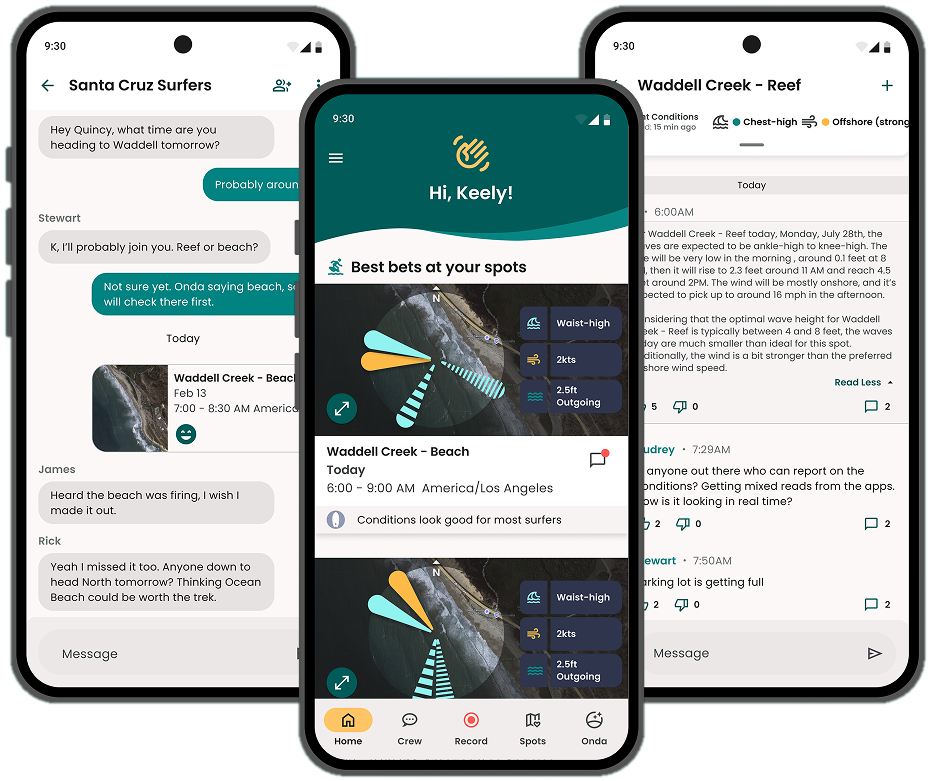
Designing surf-centered communication inside Onda
During my internship at Onda I led the design of Crew Chat, a communication feature built to keep surfers coordinated inside the product, from research through engineering-ready handoff.
Onda is a personalized surf recommendation app that helps surfers plan sessions, track performance, and share surf data. Our team had identified a gap: surfers were leaving the app to coordinate with their crew, relying on outside group chats and screenshots to plan sessions together. Before Crew Chat, that meant switching apps, repeating information, and losing the connection between the surf data and the conversation happening around it, for users and for Onda, a gap in the one moment the product should have owned.
My project was Crew Chat, designed from problem definition through engineer-ready handoff. The goal was a communication feature that felt native to Onda, one that kept surfers connected to surf data while they coordinated, without asking them to switch tools or learn new behavior.
Defining a clear MVP scope. A chat feature can easily become over-scoped, complex to build and heavy to adopt. I pulled the scope back to what people expect from any baseline chat experience, sharing sessions, @ mentions, long-press to react or reply, and mapped everything else as future iteration. That gave engineering a clear starting point instead of an open-ended feature.
Designing around real use cases. Without grounding the feature in real scenarios, chat risked feeling disconnected from how surfers actually coordinate. I mapped common coordination scenarios, built personas around different crew dynamics, and walked through a journey map of a casual surfer proposing a session to her crew, which surfaced specific interaction decisions at each stage.
Bringing surf context into the conversation. The most important thing Crew Chat could do differently from iMessage was bring surf data into the thread itself. I designed interactions letting users share sessions and forecasts directly into chat, with @ mentions and long-press actions that added control without adding complexity, so the feature felt like it belonged inside Onda instead of competing with it.
Crew Chat introduced a centralized communication space inside Onda, connecting conversation directly to the app's surf data. The MVP scope was defined, designed, and documented for engineering handoff, giving the team a clear foundation to build from. The feature hadn't shipped by the time my internship ended, but the work established a shared product direction and reduced ambiguity going into implementation: scope defined and documented, designs aligned with engineering constraints, and a real foundation for whatever iteration comes next.
Crew Chat was my primary project but not the whole summer. I also led moderated interviews and usability tests for SpotChat, a related community feature the team was evaluating, prototyped early concepts for Wavelink, and helped refine shared components and documentation for the team. Working across several features at once in a resource-limited startup taught me how to prioritize and stay useful past my own defined scope.