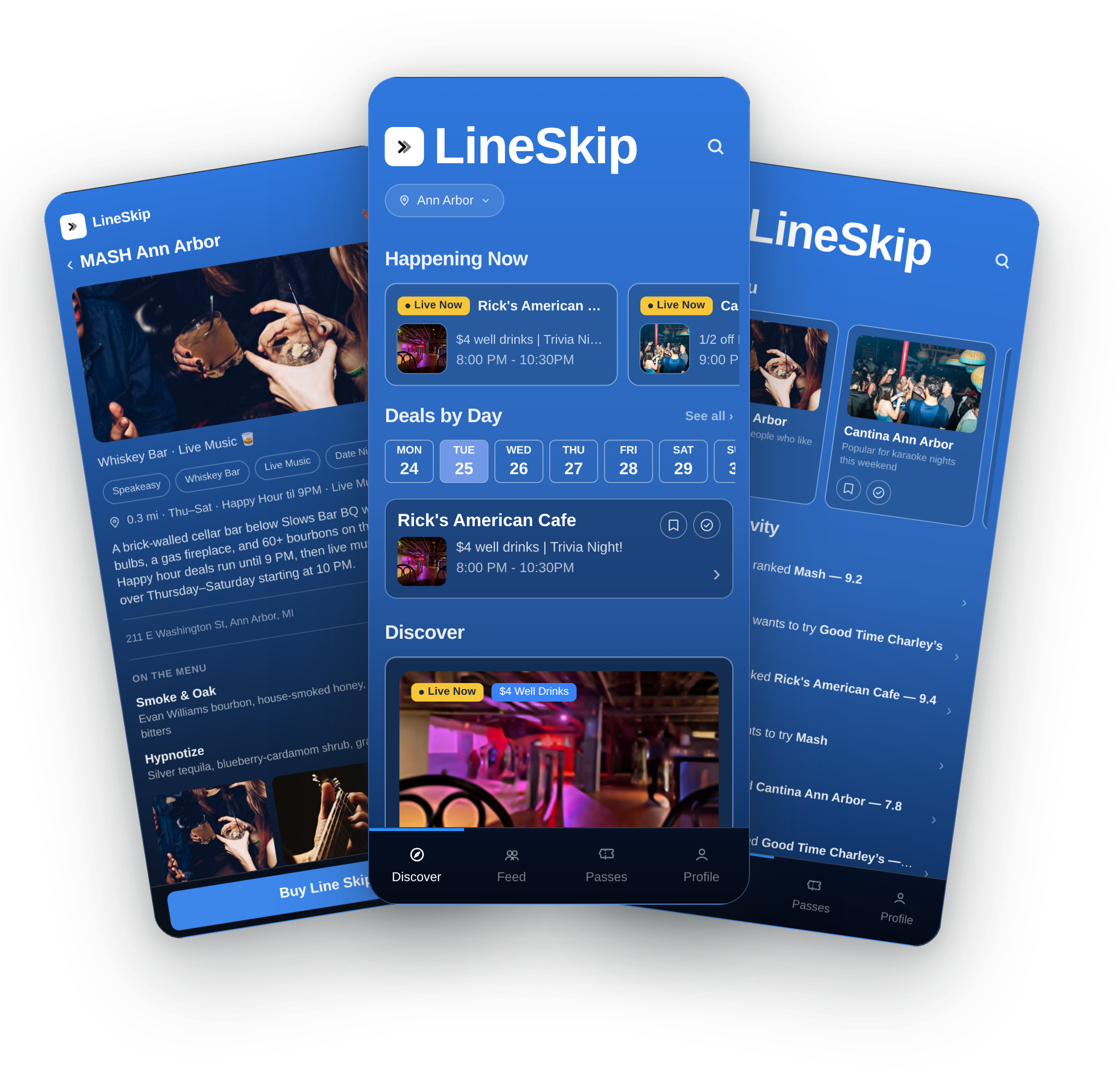
Designing real-time nightlife clarity for Ann Arbor students
LineSkip is a real-time nightlife decision and access app that lets University of Michigan students check a venue's live line, crowd, and cover before they leave. Users decide with clarity and can purchase line skip passes.
I took LineSkip from a blank problem statement, University of Michigan students go out multiple nights a week with no reliable way of knowing what to expect, to a full interaction model and visual system that could solve this uncertainty. My work in Figma included a cohesive design system, a visual language that differentiated the product, and iterating through three feature areas: live status, a redesigned visual hierarchy, and an events/deals surface. I partnered with Figma Make early on to prototype interaction flows and bring designs closer to something real. That was the work I completed in school, in Fall 2025. Revisiting the project in Fall 2026, curious about experimenting with Claude Code and Vercel, I decided to take my Figma file into AI design tools so I could ship something a stranger could actually use.
The first step in the AI phase was the handoff from Figma to Claude. I took my Figma system and turned it into real coded screens through Claude prompting. I got screens stitched together and clickable within hours and was able to apply my judgment to refine the flow and information hierarchy on a first pass. Through iterations back and forth, I brought my design thinking into the production of:
- 16 fully-routed, independent screens (business detail × 3 venues, checkout, deals, discover, event, event-drop, feed, intro, location, passes, profile, search, plus the two structural routes)
- A real persisted user state with a "been / want to try" venue tracking system, backed by local storage
- A multi-step interaction flow that generates a venue ranking modal, powered by a real scoring algorithm
After refining the product into a version that made sense stitched together, I brought everything into a build-out with Claude Code. Here I partnered with Claude Code to bring polish to interaction design, catch bugs and edge cases, and ensure the system held up to responsiveness in my own testing.
Each stage of the design process with AI workflows integrated independent verification from my own user-centered mindset and product taste.
The final part of the process was just the technical launch. I wanted to create a working product hosted beyond a Claude link. Experimenting with Vercel allowed me to deploy the product through a real hosting platform and be ready to put it in front of users.
In working with AI to build LineSkip, I learned quickly that more ideas were possible and a clear product vision could be translated into a working prototype with deliberate validation at every handoff point. It was in Figma where my design took shape, but in Claude Code I got to see if what I was building was actually the right thing.